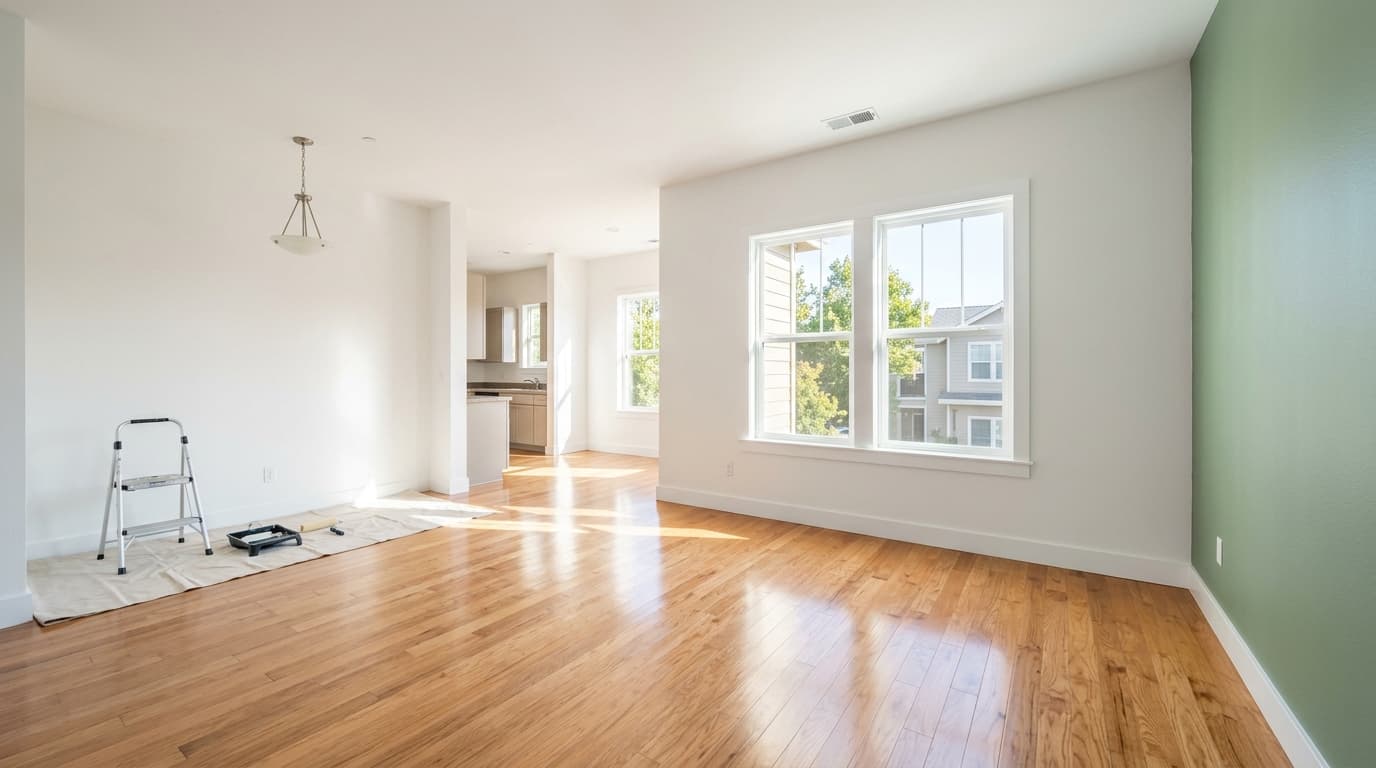
A Sacramento rental turnover package bundles interior paint, drywall patching, handyman punch list, deep cleaning, window cleaning, and exterior gutter clean into one coordinated 4 to 7 day scope -- typically $1,800 to $3,800 on a 2-bedroom unit and $3,200 to $6,500 on a single-family rental. Bundling this work with one multi-service contractor cuts turnover time by 60 to 75 percent and costs 20 to 30 percent less than chasing four separate vendors, which matters because every extra week of vacancy at Sacramento median rent ($1,950 for a 2-bed) costs a landlord roughly $487 in lost rent. This guide breaks down the full turnover scope, timing, costs, paint specs, and the scoping checklist Sacramento landlords and property managers use to run clean turnovers.
Key Takeaways
- Typical bundled cost: $1,800 to $3,800 on a 2-bed Sacramento rental, $3,200 to $6,500 on a 3/2 single-family
- Timeline: 4 to 7 business days bundled vs 3 to 5 weeks with separate vendors
- Bundle savings: 20 to 30 percent versus hiring paint, handyman, cleaning, and gutter separately
- Vacancy cost: ~$487/week lost rent at Sacramento median 2-bed rent of $1,950
- Repaint frequency: full repaint every 3 to 5 tenancies, touch-ups in between
- Standard scope: paint + drywall + handyman + deep clean + windows + gutters, one contract, one warranty
Rental turnover is where landlord margins quietly bleed. A single 2-bedroom unit in Citrus Heights sitting vacant an extra 18 days while a landlord coordinates a painter, a handyman, and a cleaner loses roughly $1,250 in rent, plus utilities the landlord is now carrying, plus the cost of fielding phone calls from three separate vendors. Across a small portfolio of 6 to 10 units, that friction compounds into five figures of avoidable vacancy every year.
The alternative is a bundled rental turnover package handled by a single multi-service contractor -- one walk-through, one sequenced crew, one invoice, one walk-through signoff, and a unit that's tenant-ready in under a week. This guide is written from inside the Sacramento rental market, where every extra week vacant is money you're not getting back, and where property managers running 20 to 50+ doors have turnover scoping down to a checklist. Whether you're a first-time landlord or managing a small portfolio, the playbook below shows exactly what belongs in a Sacramento rental turnover, what it should cost, and how to run it fast.
What's Actually in a Sacramento Rental Turnover Package
A complete rental turnover covers six service lines that almost every vacant unit needs. Missing any one of them creates a complaint from the new tenant within 30 days.
1. Interior Paint (Touch-Up or Full Repaint)
Paint is the single biggest driver of "this unit looks fresh" perception at showing. On a standard Sacramento turnover, paint is either a touch-up (matching existing color, spot-filling scuffs and nail holes) or a full repaint (every wall, every room, ceilings optional). The decision is based on how old the current paint is, how much damage is present, and whether the unit has odor saturation from pets or smoking. Details on the interior painting process for Sacramento homes apply directly to rentals, just with landlord-friendly paint specs and batch consistency rules.
2. Drywall Patching and Nail-Hole Repair
Every vacated Sacramento rental has 15 to 40 nail holes, 2 to 5 anchor holes, and usually 1 to 3 larger wall dings. These get patched, sanded, primed, and painted over during the paint phase. Trying to separate drywall and paint into two vendors creates a scheduling gap and doubles the mobilization cost for no value. Bundle them. Full drywall repair pricing details cover the standard Sacramento rates.
3. Handyman Punch List
The handyman punch list is where most turnover scope creep hides. Typical items on a Sacramento rental turnover punch list:
- Door strikes adjusted, hinges tightened, sticky doors planed
- Loose cabinet hardware retightened or replaced
- Broken or missing outlet and switch covers
- Loose toilet seats, running toilets, slow drains
- Smoke detector and CO detector testing, battery replacement
- HVAC filter replacement
- Loose baseboards or quarter-round nailed back down
- Broken blinds or torn screens
- Burned-out bulbs replaced uniformly (LED soft white throughout)
- Caulk refresh at tub, sinks, and baseboards where failed
- Shower rod or towel bar tightened or reanchored
- Missing bumpers on cabinet doors
- Garage door opener battery, weatherstripping check
A tight handyman punch list runs 10 to 20 items on a standard 2-bed Sacramento rental. Missing any of these at move-in triggers a maintenance request within the first 14 days, which is both a cost and a tenant-relationship problem on day one.
4. Deep Clean (Move-Out Clean)
The move-out clean in Sacramento rentals is always a deep clean, not a regular clean. Inside appliance interiors (oven, fridge, microwave, dishwasher), inside cabinets and drawers, behind and under appliances, window tracks, blind slats, bathroom grout, tile, fixtures, and a full floor clean or carpet detail. Most Sacramento property managers run this after paint and handyman complete, not before, because paint dust and handyman debris will recontaminate an early clean.
5. Window Cleaning (Interior and Exterior)
Vacant-unit window cleaning hits both sides of every window plus tracks. This is the single easiest-to-skip line item that makes the biggest visible difference at showing. A unit with dirty windows photographs terribly on listing photos and shows even worse in person. Our Sacramento window cleaning cost guide covers the per-window and whole-unit pricing for rentals.
6. Exterior Gutter and Entry Cleaning
On single-family rentals and some duplexes, the gutters are the landlord's responsibility. A turnover is the right moment to clean them (and the entryway, porch, and walkway) because the unit is vacant and the crew is already on site. A full gutter cleaning scope runs about $150 to $300 on a single-story Sacramento rental and takes 1 to 2 hours.
Pro Tip
Bake a "landlord base scope" into your property management agreement or personal turnover SOP that lists every service line above with a yes/no decision point. When a tenant gives notice, you don't renegotiate the scope -- you run the checklist, flag what the specific unit needs, and send that list to your multi-service contractor. That alone cuts turnover scoping time from 3 to 5 days down to 1 hour.
What a Sacramento Rental Turnover Costs in 2026
Turnover cost depends on unit size, condition at move-out, and how many of the six service lines you bundle. Here's what bundled turnover packages typically run across Sacramento's rental stock.
| Unit Type | Touch-Up Turnover | Full Repaint Turnover | Timeline |
|---|---|---|---|
| Studio / 1-bed apartment (500-700 sf) | $900 - $1,600 | $1,400 - $2,400 | 3 - 5 days |
| 2-bed / 1-bath apartment (800-1,100 sf) | $1,200 - $2,200 | $1,800 - $3,800 | 4 - 7 days |
| 3-bed / 2-bath apartment (1,100-1,400 sf) | $1,600 - $2,800 | $2,400 - $4,800 | 5 - 8 days |
| 3/2 single-family rental (1,400-1,800 sf) | $2,200 - $3,800 | $3,200 - $6,500 | 6 - 10 days |
| 4/2 single-family rental (1,800-2,400 sf) | $2,800 - $4,800 | $4,200 - $8,500 | 8 - 12 days |
| ADU / granny flat (400-800 sf) | $800 - $1,400 | $1,200 - $2,400 | 3 - 5 days |
These ranges assume fully vacated units, no major damage, and standard Sacramento labor rates. Add-on scopes that push pricing higher include carpet replacement ($1.50 to $3.50 per square foot installed), full flooring refresh (see our Sacramento flooring installation cost guide), cabinet painting ($800 to $2,400 -- details in the cabinet painting cost breakdown), or exterior repaint if the unit is a detached single-family with tired exterior coating.
Typical Sacramento 2-Bed Turnover Cost Breakdown
Sample scope on a Sacramento 2-bed, 1-bath rental at standard turnover condition. Line items scale with unit size and damage level.
The Real Cost of a Slow Sacramento Turnover
The mistake most small landlords make is optimizing for cost per line item instead of speed to re-rent. Labor rate on the painter matters a lot less than how many days the unit sits empty. Here's the math that most Sacramento landlords miss.
According to the RentCafe Sacramento market report, the average 2-bedroom apartment rent in Sacramento as of early 2026 is roughly $1,950 per month, or about $65 per day. On a single-family rental, the daily carry is higher -- $85 to $120 per day on a typical Sacramento SFR. Every day of unnecessary vacancy is that much rent you're not banking, plus utilities you're paying as the landlord (water, trash, sewer, sometimes gas for pilot lights), plus advertising costs, plus the increased risk that a good applicant rents somewhere else because your unit wasn't ready for them.
Here's what that looks like in dollars across typical Sacramento turnover scenarios:
- Bundled turnover, 2-bed apartment: 5 working days vacant during prep = $325 in lost rent
- Separate-vendor turnover, 2-bed apartment: 24 calendar days vacant during prep = $1,560 in lost rent
- Bundled turnover, 3/2 SFR: 8 working days vacant during prep = $720 in lost rent
- Separate-vendor turnover, 3/2 SFR: 32 calendar days vacant during prep = $2,880 in lost rent
On the SFR scenario, the extra three weeks of vacancy from running separate vendors costs $2,160 more in lost rent than the ~$600 you "save" by shopping each line item. That's the reason Sacramento property managers with 20+ doors standardized on bundled vendors years ago -- the math stops working the moment you count vacancy.
The Sacramento Rental Turnover Sequence (Day by Day)
A properly sequenced turnover runs like a small remodel: every trade layered so no crew is waiting on another. Here's the day-by-day on a standard Sacramento 2-bedroom apartment with a full repaint.
- Day 1 -- Walk-through, punch list build, move-out inspection photos. Crew lead walks the unit with the landlord or PM, documents damage beyond normal wear and tear (for deposit purposes), confirms scope. Handyman begins hardware and punch items that don't require empty walls -- reanchoring towel bars, tightening cabinet hinges, replacing outlet covers, testing smoke detectors.
- Day 2 -- Drywall patching and prep. All nail holes, anchor holes, and wall damage patched, sanded. Small-scale caulk refresh at baseboards and tub. Handyman continues interior punch items in untouched rooms.
- Day 3 -- Ceilings and cut-in. Ceiling paint if in scope. Primer on patched spots. Cut-in work (edges, corners, around trim) on wall paint begins.
- Day 4 -- First coat walls, trim touch-up. Full first coat rolled on walls. Trim and doors touched up in semi-gloss. Handyman completes remaining punch list in rooms where paint is already drying.
- Day 5 -- Second coat walls, final paint inspection. Second coat rolled. Crew lead does paint QC walk, lists touch-up points.
- Day 6 -- Final touch-ups, deep clean. Paint touch-ups at inspection points, then full deep clean of every room including appliances, inside cabinets, bathrooms, floors. Window cleaning interior.
- Day 7 -- Exterior window clean, gutter clean (if SFR), final walk-through. Exterior windows, gutters if in scope, porch and entry sweep. Final walk-through with landlord or PM. Keys returned or re-coded. Unit photographed for new listing.
That's 7 working days with paint, drywall, handyman, and cleaning layered correctly. Try to run it with four separate vendors and the same scope stretches to 20 to 30 calendar days because each vendor has to mobilize, complete, demobilize, and wait for the next one to become available.
Turnover Timeline: Bundled vs Separate Vendors
Timing assumes a standard Sacramento 2-bed unit with full repaint. Separate-vendor gaps are the typical 5 to 10 business day booking delay between trades.
Sacramento Landlord Paint Specifications
Paint is where a smart Sacramento landlord builds long-term turnover efficiency. The one-time decision to standardize on a single interior paint color and batch across every unit in your portfolio permanently lowers your turnover cost. Every subsequent touch-up turnover becomes a 2-day paint job instead of a 5-day repaint, because you're never matching new paint to an old color -- it's all the same spec.
The Landlord White Strategy
The most common Sacramento rental paint spec across property management portfolios is a warm off-white in flat sheen for walls and semi-gloss on trim and doors. Flat hides wall imperfections so patches blend. Semi-gloss on trim cleans with a damp rag rather than requiring a repaint every turnover.
The four warm off-whites most commonly specified on Sacramento rentals:
- Sherwin-Williams SW 7008 Alabaster -- warm creamy white, reads clean but soft, hides dust and minor scuffs well
- Sherwin-Williams SW 7036 Accessible Beige -- warm greige, hides more wear, popular on heavier-traffic rentals
- Sherwin-Williams SW 7029 Agreeable Gray -- lightest gray that still photographs warm, photograph-friendly for listing photos
- Benjamin Moore OC-17 White Dove -- softer warm white, premium-feeling finish on higher-end rentals
For the deeper strategy on paint color and ROI -- especially useful when a unit is being readied as a potential future sale -- see our guide on the best paint colors to sell a house in Sacramento. Many of the same colors that photograph well for resale also work brilliantly on rentals because the lighting and staging challenges are similar.
Why Batch Consistency Matters More Than Color Choice
Once you pick a color, stay in the same batch (same manufacturer, same product line, same color code, same sheen) across every unit and every turnover. Mixed batches on a single wall flash visibly even when the color code is identical, because paint production batches vary by tiny tints. Sacramento landlords who skip batch consistency end up with walls that require full repaint on every turnover because touch-ups don't blend. Landlords who commit to one batch can run paint touch-ups instead of full repaints for years.
Pro Tip
Keep a gallon of your landlord-spec paint stored on-site at every property, labeled with the date, color code, and batch number. On any small-damage turnover, that gallon plus 30 minutes of a handyman's time is the whole paint job -- no full repaint, no half-day painter visit, no matching headaches. For a small Sacramento portfolio, this trick alone saves $400 to $800 per turnover.
Touch-Up vs Full Repaint: The Sacramento Decision Framework
The single biggest cost variable in a turnover is whether you run a full repaint or a touch-up. Here's the framework most Sacramento property managers use:
Run a Touch-Up When:
- Existing paint is less than 4 years old
- You have the matching paint batch stored
- Damage is localized -- nail holes, small scuffs, one or two dings
- No pet or smoke odor
- Tenant left the unit in reasonable condition
- Previous paint job was professionally done and hasn't yellowed or chalked
Run a Full Repaint When:
- Paint is 5+ years old or visibly worn
- You're changing color across the portfolio
- Wall damage exceeds ~15 percent of wall area
- Pet or smoke odor is saturated into walls (must prime with stain-blocking primer, then two topcoats)
- Previous paint is flashing, yellowing, or applied in an outdated finish
- Unit is being repositioned to a higher rent tier
- You don't have batch-matched paint on hand
Most Sacramento rentals land on a schedule of touch-up turnovers for 3 to 4 tenancies in a row, then a full repaint on the 4th or 5th turnover when accumulated wear finally pushes it there. Budget the full repaint into your operating expenses on a rolling 5-year cycle and you'll never be caught off guard by the cost.
Coordinating With Tenant Move-Out (Scoping the Work)
The turnover sequence actually starts before the unit is vacant. The 30-day notice window is when you scope, schedule, and pre-book your turnover vendors so you're not scrambling after keys come back.
- Day -30 (notice received). Confirm move-out date in writing. Send tenant the move-out expectations checklist -- what constitutes normal wear versus damage, cleaning expectations, key return process. Request a move-out walk-through window.
- Day -21. Schedule your turnover contractor walk-through for the day after vacate. Put the crew on the calendar. This is the single most important step -- waiting until move-out to book usually costs you 1 to 3 extra weeks of vacancy during peak turnover season (May to August in Sacramento).
- Day -14. Begin marketing the unit. List on Zillow, Apartments.com, and local Sacramento-specific listing sites. Use prior-turnover photos if the unit looks similar; update after this turnover completes.
- Day -7. Finalize turnover scope based on expected condition. Confirm paint (touch-up or full), flooring status, any upgrades timed to this turnover (appliance, fixture).
- Day 0 (tenant vacates). Tenant returns keys. Same-day or next-day move-out inspection with photos. Send scope update to turnover contractor based on actual condition.
- Day 1 to Day 7. Turnover runs per the 7-day bundled sequence above.
- Day 7 to Day 10. Showings begin, lease applications reviewed, new tenant identified, lease signed.
- Day 10 to Day 14. New tenant move-in. Lease starts. Rent resumes.
That full cycle -- notice received to new tenant moved in -- is 44 days. Miss any of the pre-booking steps and the cycle stretches to 60+ days, which at $65/day on a 2-bed costs an extra $1,000+ in vacancy. For small landlords juggling this alongside a day job, pre-booking the turnover crew on day -21 is the single highest-leverage move you can make.
Seasonal Timing in Sacramento Rentals
Sacramento rental turnover volume is seasonal. Demand for turnover services spikes May through August as leases end and tenants relocate before school starts or during the summer moving window. Bookings tighten, and a contractor who was available in 3 days in February might be 3 weeks out in July.
Some scheduling realities Sacramento landlords operate around:
- Peak turnover season (May-August): book vendors 3 to 4 weeks in advance. Expect pricing 5 to 10 percent higher due to demand. Exterior work (gutter cleaning, exterior paint) squeezed in before the 100F+ days arrive.
- Shoulder season (April, September, October): excellent timing for turnovers with more scheduling flexibility. See our spring home maintenance checklist for the outdoor tasks you can roll into an April turnover.
- Rainy season (November-February): interior paint and handyman still run normally. Gutter cleaning is critical before the first atmospheric river -- line that up with any fall turnover via our fall home prep guide.
- Summer heat days (July-August): exterior paint on single-family rentals becomes tough above 95F. Schedule exterior scopes for early morning (6 AM-10 AM) or push to September.
Portfolio Efficiency: Multi-Unit Turnover Scheduling
If you're managing more than 3 or 4 Sacramento rental units, turnover efficiency compounds in ways that single-unit landlords don't see. A contractor running a turnover on Tuesday can be on another of your units on Friday -- same crew, same paint spec, same process, same supply run.
The advantages multiply when you standardize across a portfolio:
- One paint spec across all units. Single paint order, single supplier relationship, zero color-matching. Big-box or pro-paint store accounts give 5 to 15 percent discounts on bulk orders once you're buying 15+ gallons a year.
- One vendor relationship. Priority booking, same project manager, faster response time, standardized scope document. Property managers with 20+ doors typically negotiate retainer pricing with a multi-service contractor for guaranteed turnover capacity.
- Batched hardware purchases. Door strikes, cabinet pulls, outlet covers, smoke detectors bought by the case, distributed across turnovers. This alone saves 20 to 40 percent on hardware line items.
- Shared walk-through process. One scoping template, one condition report format, one photo checklist. Every turnover looks identical from a documentation standpoint, which is invaluable if a tenant dispute goes to mediation.
- Emergency capacity. When a unit comes vacant unexpectedly (tenant bails early, eviction, damage), the vendor relationship means you get on the schedule within days instead of weeks.
A Real Sacramento Rental Turnover Scenario
Here's a turnover we ran this spring in Arden-Arcade. The unit was a 2-bedroom, 1-bath apartment in a small 4-plex, 1,000 square feet, occupied by the same tenant for 4 years. Tenant gave 30 days notice in early March. Unit was in reasonable condition -- some wear, normal nail holes, a few scuff marks, one dog that had been on the lease throughout.
Scope landed on a full repaint (paint was 6 years old and starting to yellow), a 17-item handyman punch list, full deep clean, interior and exterior window wash, and replacement of 4 outlet covers and the kitchen faucet (flagged at the move-out walk-through).
Timeline:
- Day 0 (Friday): Tenant vacates. Same-day move-out inspection, photos, condition report.
- Day 1 (Monday): Crew on site. Punch list items started, drywall patching begins.
- Day 2-3: Drywall sanded and primed. Punch list items continue. Faucet replaced.
- Day 4-5: Full repaint, two coats on walls, trim touch-up. Color: SW 7036 Accessible Beige flat, trim in SW 7008 Alabaster semi-gloss.
- Day 6: Deep clean, including interior of appliances, inside cabinets, bathrooms, floors. Interior window wash.
- Day 7: Exterior window clean, common-area gutter clean (exterior of the 4-plex shared with neighbors), final walk-through with landlord.
Scope complete in 7 working days. Total cost: $2,685 bundled. New listing went live on day 8 with fresh photos. Lease signed on day 16, new tenant moved in on day 21. Vacancy cost: roughly $1,365. Same scope run through separate painter, handyman, cleaner, and window vendor would have stretched to 25+ calendar days of prep plus showing time, pushing vacancy to 40+ days and lost rent closer to $2,600. The bundled turnover saved about $1,200 in recaptured rent plus roughly $600 in direct scope pricing -- so $1,800 total on a single unit.
Scoping a Sacramento Turnover Contractor
Picking the right contractor for rental turnovers is different from picking one for an owner-occupied renovation. Landlords and property managers need speed, repeatability, and paperwork -- not custom design or high-touch hand-holding. The questions to ask:
- Can you deliver a line-item turnover quote from the property address alone? Good contractors can price a standard turnover from the unit size and condition report without a 90-minute walk-through. You don't have time for that on every turnover.
- What's your typical turnover timeline on a standard 2-bed Sacramento unit? Answers in the 5 to 8 day range are realistic. "2 to 3 weeks" is a red flag.
- Do you carry inventory of common landlord supplies? Outlet covers, smoke detectors, cabinet bumpers, standard door hardware, batch-matched paint in common landlord colors. Saves a supply run per turnover.
- Can you photograph before-and-after for condition documentation? This is critical for deposit disputes and rental condition records.
- What's your CSLB license classification? B General Building covers multi-service work. C-33 painting is useful if they self-perform paint.
- Do you offer retainer or priority booking for portfolio landlords? The answer tells you whether they want the repeat business or treat every call as a one-off.
- What's your single-contract warranty on turnover work? Standard is 1 year on paint, 90 days on punch-list work, 30 days on cleaning. Should be clearly stated.
For the broader contractor vetting framework -- CSLB lookup, insurance verification, red flags -- see our Sacramento home improvement contractor hiring guide, which applies directly to rental turnover vendor selection.
Total Turnover Cost: Bundled vs Separate Vendors
Sample Sacramento 2-bed turnover at $65/day in median rent. Bundled scenario assumes single multi-service contractor handling all six service lines over 7 working days. Separate-vendor scenario assumes typical booking gaps and 28 total vacant days.
Common Turnover Scope Add-Ons in Sacramento
Not every turnover is a straight paint-plus-clean. Here are the scope extensions Sacramento landlords most commonly layer onto turnovers when condition or strategy requires it.
- Carpet replacement or professional carpet clean. Carpet replacement is usually warranted every 2 to 3 tenancies in Sacramento rentals; professional deep clean works between replacements. Budget $1.50 to $3.50 per square foot installed for carpet; $200 to $400 for professional clean.
- Flooring refresh. LVP upgrades are popular on Sacramento rental refreshes because they're durable, waterproof, and don't need to be replaced between tenants. See our Sacramento flooring installation cost guide for current pricing.
- Cabinet painting. When kitchen cabinets look dated but are structurally fine, paint can extend their life 5 to 10 years. The cabinet painting cost breakdown walks through Sacramento pricing.
- Appliance replacement. Refrigerator, dishwasher, or range replacements are commonly timed to turnover because the unit is empty. Budget $700 to $1,800 per appliance installed.
- Pressure washing. On single-family rentals and some townhomes, a full exterior pressure wash of siding, driveway, patios, and fences gives the unit visible curb appeal at first showing. Our Sacramento pressure washing guide covers scope and pricing.
- Full exterior refresh. On higher-end SFR rentals, some landlords combine turnover with exterior paint and gutter work. See the exterior home refresh cost guide for bundled pricing on this combination.
- Smart lock or keypad install. Replacing traditional keys with smart locks eliminates the rekey cost at every turnover. $200 to $400 installed, saves $80 to $150 per turnover in rekey fees.
- Light fixture upgrade. Swapping dated fixtures with clean modern LED fixtures is a cheap photo-friendly upgrade -- $50 to $150 per fixture installed.
Pro Tip
Rental turnover is the one moment when upgrade scope is cheapest to execute because the unit is empty and your crew is already on site. Batch your "someday" improvements into turnover scope instead of doing them one-off while the unit is occupied. A cabinet repaint that costs $1,800 during a turnover might cost $2,400 mid-tenancy because the crew has to tape, protect, and work around a tenant's daily life.
What a Good Turnover Report Looks Like
One output most small Sacramento landlords skip but every property manager depends on is a turnover report: a photo-documented record of unit condition before and after turnover, scope completed, condition changes, and any deposit deductions tied to specific documented damage.
A good Sacramento turnover report contains:
- Pre-turnover photos of every room, every wall, every fixture, every appliance exterior and interior
- Line-item scope list with completion date and crew member who signed off each item
- Post-turnover photos in the same framing and lighting as the pre-photos
- Note on any condition change from pre to post (wall damage repaired, cabinet hinge tightened, faucet replaced, etc.)
- Itemized costs tied back to the scope list
- Warranty statement with effective dates
- Next-maintenance recommendations (next touch-up vs repaint, next flooring refresh, etc.)
That document is legally invaluable if a deposit dispute ends up in small-claims court, and operationally invaluable when the next tenant leaves and you're scoping the next turnover. Our pre-listing repair checklist has a similar photo-documentation framework; the same discipline applies to rental turnovers.
When to Outsource vs DIY the Turnover
Small Sacramento landlords sometimes ask whether they should DIY the turnover to save money. The honest answer is: it depends on how you value your weekends and how empty your calendar is.
- DIY makes sense when: you're between jobs with time flexibility, you have painting and handyman experience, you own the tools, you have no time-pressure on re-renting, and the unit needs only touch-up work (1 to 3 full days of effort).
- Outsource when: you have a day job, you own 2+ units, the unit needs full repaint, the turnover involves more than one service line, you're in peak rental season (May-Aug), or you can't knock out the full scope in under a week yourself.
For Sacramento landlords with 3+ units, outsourcing becomes mathematically obvious once you count the time cost. Ten days of your weekends on a DIY turnover at your hourly rate plus the vacancy cost of that same 10 days usually exceeds a bundled contractor quote by $1,500 or more.
Putting It All Together: The Sacramento Rental Turnover Playbook
A professional Sacramento rental turnover is less about what work gets done and more about how fast the work gets done, how well it's documented, and how consistently it runs across turnover after turnover. The one-time investment in standardizing your paint spec, your hardware palette, your scope checklist, and your vendor relationship pays back 5 to 10x over the next 3 years across your portfolio.
The quick playbook:
- Pre-book your turnover vendor the day you receive a 30-day notice, not the day the unit is vacant
- Standardize on one paint spec and batch across the entire portfolio
- Use a bundled multi-service contractor for paint, handyman, clean, windows, and gutters
- Keep a landlord-white paint gallon on-site at every property for micro-turnovers
- Run a full repaint every 3 to 5 tenancies, touch-up in between
- Generate a photo-documented condition report every turnover
- Price turnover by total cost including lost rent, not just line-item cost
- For portfolio landlords, negotiate retainer or priority-booking terms with your multi-service vendor
Across a 5-unit Sacramento portfolio running 1 to 2 turnovers per year per unit, a bundled turnover approach saves roughly $8,000 to $15,000 annually versus DIY or separate-vendor alternatives -- just from faster re-rent timelines and lower scope friction. For larger portfolios the savings scale linearly. For more on how the multi-service bundling advantage works in general, see why bundling paint, gutters, and handyman work saves time and money.
Get Your Sacramento Rental Turnover Scoped
ProFlow Home Services runs bundled rental turnover packages across Sacramento and the surrounding Sacramento County, Placer County, and El Dorado County rental markets -- including Sacramento, Roseville, Rocklin, Citrus Heights, Carmichael, Folsom, Elk Grove, Rancho Cordova, Granite Bay, Lincoln, Loomis, and Fair Oaks. One contractor, one walk-through, one sequenced timeline, one invoice. Paint, drywall, handyman, deep clean, windows, and gutters coordinated end-to-end so your unit is tenant-ready in under a week from keys in hand.
For portfolio landlords and small property managers, we offer retainer-based priority booking with guaranteed turnover capacity in peak season -- which matters most when three units come vacant the same month during summer and you can't afford to have any of them sit. We bundle interior painting, handyman services, pressure washing, gutter cleaning, and exterior painting into single-contract scopes priced by line item so you can see exactly what you're paying for -- and exactly where the bundle savings come from.
Request a rental turnover estimate and we'll walk the unit, build the scope, and deliver a line-item turnover quote with a day-by-day timeline -- before your current tenant even vacates.